Executing a commercial build in North Texas requires a shift in perspective from standard residential construction. In our experience, the combination of North Texas geological volatility and the city’s rigorous engineering standards means that “good enough” often leads to structural failure within five years. Before you break ground on a commercial concrete Frisco project, you must account for specific local variables. From “Black Gumbo” clay management to the high-heat pouring protocols required for the 105°F summer season, this guide outlines the technical benchmarks every developer needs to verify.
Whether you are in the process of choosing the right commercial concrete contractor in Frisco or drafting a master plan for large-scale flatwork in Frisco, the following engineering standards are the baseline for success.
1. Soil Stabilization: Managing the Black Gumbo Clay
The single greatest threat to concrete foundations in Frisco is the region’s expansive clay. This soil acts like a sponge, expanding when wet and shrinking during droughts, which can exert thousands of pounds of pressure on a slab. This is a primary driver behind common foundation issues in North Texas soil.
PVR Testing and Chemical Injection. Ensure your contractor reviews the Potential Vertical Rise (PVR) from your geotechnical report. If the PVR is high, the soil may require chemical injection. We often see the use of lime or sulfate-resistant fly ash to stabilize the plasticity of the clay. Skipping this step is a common pitfall that leads to “slab heaving,” where the center of your warehouse floor rises several inches, creating a massive liability for equipment and safety.
Moisture Conditioning Protocols. A common mistake we see is pouring on bone-dry clay. In our experience, the subgrade must be moisture-conditioned to a specific percentage. This prevents the soil from sucking the water out of your concrete mix, which causes bottom-up cracking. This preparation is a core part of the concrete driveway installation process in Frisco for heavy-duty commercial entrances.
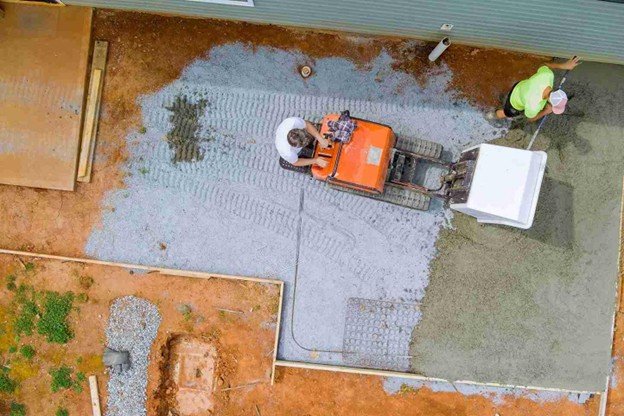
Flex Base and Mechanical Compaction. For commercial-grade concrete placement in Frisco, we utilize a 6-inch to 8 inch compacted flex base. This provides a non-expansive buffer between the clay and your concrete. We coordinate with third-party labs to perform Nuclear Density Testing, ensuring the subgrade has reached 95% to 98% Proctor density.
2. Engineering Specifications for Commercial Loads
A commercial slab is not a “one size fits all” installation. The mix design must be engineered for the specific traffic and equipment loads of the facility. This is a key part of slab foundation requirements in Frisco, TX.
Compressive Strength (PSI) and Mix Design. While 3,000 PSI is standard for homes, commercial retail and warehouse projects in Frisco typically require 4,000 to 4,500 PSI. If you are building for heavy industrial use, see our guide on flatwork thickness requirements for commercial projects. We specify air-entrained concrete (5% to 7%) to protect the internal structure from the freeze-thaw cycles common in North Texas winters.
Point Loading and Thickened Slabs. If your facility includes heavy racking or medical machinery, the contractor must calculate point loads. This often requires thickened slabs—sometimes up to 8 or 10 inches—in specific zones to prevent localized punching shear. This level of detail is what separates a professional commercial concrete contractor in Frisco: what to know before you build from a standard flatwork crew.
Reinforcement Choice: Rebar Over Mesh. We recommend #4 rebar on 12-inch centers for most commercial concrete applications. While some crews push for wire mesh to save on labor, mesh rarely stays in the center of the slab during the pour, rendering it useless for structural tension. Proper placement using rebar chairs is non-negotiable for structural continuity.
3. Navigating City of Frisco Inspections and ADA Compliance
Frisco is known for having some of the most stringent inspection processes in the DFW metroplex. Failing to plan for these stop-points can lead to massive consequences for commercial concrete scheduling impacts projects in Frisco.
Pre-Pour Verification. The city requires an inspection of the forms, the vapor barrier (minimum 15-mil for commercial), and the rebar chairs before a single yard of concrete is delivered. This is a standard part of concrete placement. We coordinate these windows at least five business days in advance to avoid project standstills.
ADA Precision and Slope Requirements. Accessibility is a major liability. Frisco inspectors use digital levels to verify handicap ramps. If a slope exceeds the allowed ratio by even a fraction, the city will mandate a full tear-out. This is a frequent issue in concrete paving Frisco projects that connect to public sidewalks.
Right-of-Way (ROW) Permits. If your project involves paving that connects to city streets, you must have specific ROW permits and adhere to Frisco’s “Standard Details” for curb and gutter transitions. This is especially true for road construction standards for Frisco subdivisions.
4. Thermal Control and Curing Protocols
The North Texas climate is brutal on fresh concrete. High winds and extreme heat accelerate the “set time,” which can lead to “Flash Setting” and surface map-cracking.
Midnight Pours and Liquid Nitrogen. During the summer months, we often coordinate with batch plants for 2:00 AM pours. This allows the concrete to reach its peak internal temperature during the coolest part of the day, reducing thermal shock. For massive foundations, we may inject liquid nitrogen into the mix at the plant to lower the “as-delivered” temperature.
Wet-Curing and Moisture Retention. For high-spec floors, especially warehouse & retail slab standards in Frisco, we utilize wet-curing blankets for seven days. This ensures the maximum hydration of the cement particles, resulting in a much harder, more abrasion-resistant surface. This process is vital for preventing cracking in large concrete slabs in Frisco.
5. Floor Flatness (FF) and Levelness (FL)
Modern commercial tenants require Super Flat floors. This is no longer a matter of opinion but a measurable engineering requirement.
Laser Screed Technology. To achieve the FF/FL numbers required for modern leases, your contractor should utilize a laser-guided screed. Manual strike-off methods are rarely accurate enough to meet commercial tolerances. This technology is a cornerstone of our large-scale flatwork services.
Profilograph Testing. A reputable contractor will offer third-party testing to verify that the slab meets the specified flatness numbers before the interior build-out begins. This testing provides a certified report that the floor meets the requirements for automated robotics or high-reach forklifts.
6. Moisture Mitigation and Vapor Barriers
A commercial slab is only as functional as the flooring that sits on top of it. Moisture vapor rising through the slab is the number one cause of commercial flooring failure in humid North Texas.
High-Performance 15-Mil Vapor Retarders. In our experience, skipping a 15-mil vapor barrier leads to moisture vapor emission issues that will delaminate future floor coatings or adhesives. This is a standard requirement for concrete foundations in retail and medical spaces.
MVER and RH Testing. Before installing flooring, we perform Calcium Chloride and In-Situ Relative Humidity (RH) testing. We aim for a Moisture Vapor Emission Rate (MVER) of less than 3 lbs per 1,000 sq. ft. By planning for this early, you avoid the long delays that happen when a wet slab stalls your interior finish-out.
7. Subdivision and Residential Transitions
Oftentimes, a commercial development in Frisco will border residential neighborhoods. Understanding the nuance between commercial paving and the standards for subdivision concrete in Frisco is vital.
Subdivision Standards. When building residential access, contractors must adhere to concrete timelines for subdivision builds in Frisco. The logistics of planning concrete access roads in Frisco developments require a contractor who can manage high truck volume without disrupting existing residents.
Driveway and Access Points. Even for commercial entryways, the finish matters. We often integrate decorative concrete Frisco to improve curb appeal at office park entrances. However, the structural base remains far superior to a standard driveway installation in Frisco.
8. Vetting Your Commercial Contractor
To separate legitimate commercial experts from high-volume residential crews, ask targeted questions about their operational maturity.
- Equipment Ownership: Do they own their own Laser Screeds and Power Trowels? Ownership indicates a contractor has control over their quality and schedule.
- Safety Record: Ask for their Experience Modifier Rate (EMR). A commercial contractor must have a solid safety record to work on high-value sites.
- SWPPP Compliance: Frisco is aggressive about Stormwater Pollution Prevention Plan (SWPPP) enforcement. Your contractor must have a plan for concrete washout to avoid five-figure city fines.
Frequently Asked Questions
How does Frisco’s soil affect my foundation cost? Because of the expansive clay, you can expect higher costs for subgrade stabilization compared to regions with stable sandy soil. This is a critical factor in avoiding concrete delays in Frisco residential developments.
What is the best time of year to pour commercial concrete in North Texas? Spring and Fall offer the most forgiving temperatures, but with proper planning, we pour year-round.
Is concrete better than asphalt for Frisco developments? Yes. When looking at concrete vs asphalt for commercial developments in Frisco, concrete offers a much higher return on investment due to its ability to withstand the Texas heat without rutting.