Selecting a partner for a commercial build in North Texas is no longer just about comparing line-item bids. In our experience, the industrial and retail growth along the North Platinum Corridor and the PGA District has shifted the requirements from basic flatwork to complex structural engineering. A contractor who treats a commercial slab like a residential driveway puts your entire investment at risk.
To ensure a 30-year lifecycle for your facility, you need a partner who understands the specific geological and regulatory environment of North Texas. This guide outlines the technical and operational benchmarks required to identify a legitimate commercial expert in the current Frisco market. Whether you are looking for a Commercial Concrete Contractor in Frisco: What to Know Before Your Build or simply vetting a crew for Commercial Concrete Frisco, these standards are non-negotiable.
1. Analyzing the Frisco Soil and Subgrade Strategy
The most significant risk to any concrete structure in Frisco is the expansive Black Gumbo clay. If a contractor does not lead the conversation with a subgrade stabilization plan, they are not qualified for commercial work. In our experience, the shrink-swell cycle of local clay can exert enough pressure to snap a 5-inch slab that lacks proper preparation. This is a primary driver behind Common Foundation Issues in North Texas Soil.
Geotechnical Compliance and PVR. A professional contractor will start by reviewing your Geotechnical Report to determine the Potential Vertical Rise (PVR). We see a common pitfall where crews skip this step and guess the soil moisture levels. A true commercial partner will discuss moisture conditioning the clay to reach a permanent moisture state before any forms are set. This is especially critical for Concrete Foundations Frisco, where structural loads are high.
Mechanical Stabilization and Flex Base. Look for a contractor who specifies a minimum 6 inch compacted Flex Base. This layer of crushed recycled concrete acts as a capillary break. It prevents the underlying clay from wicking moisture away from the bottom of your concrete slab, which is the primary cause of bottom-up curling and structural cracking in North Texas. This preparation is a core part of the Concrete Driveway Installation Process in Frisco for heavy-duty commercial entrances.
Subgrade Compaction Testing. Do not hire a contractor who eyeballs the compaction. A commercial-grade partner will coordinate with a third-party lab to perform Nuclear Density Testing. This ensures the subgrade has reached 95% to 98% Proctor density, providing a rock-solid foundation that prevents the slab from sinking or shifting under the weight of delivery trucks.
2. Engineering for Strength: PSI and Mix Design
Commercial projects in Frisco require much higher performance from the concrete mix than a standard residential job. When reviewing bids, look for specific mix designs rather than generic 4-bag or 5-bag talk. This is what separates Choosing The Right Commercial Concrete Contractor in Frisco from hiring a residential crew.
Compressive Strength and Load Requirements. While 3,000 PSI is fine for a backyard patio, commercial retail and warehouse slabs require 4,000 to 4,500 PSI. If your facility will house heavy medical imaging equipment or high-density warehouse racking, the contractor should calculate the Point Loading requirements to ensure the concrete can handle the specific weight distribution. This information is detailed further in our guide on Flatwork Thickness Requirements for Commercial Projects.
Chemical Admixtures and Air Entrainment. In the DFW metroplex, ice storms are a reality. Your contractor must specify a mix with 5% to 7% air entrainment. These microscopic air bubbles provide space for internal hydraulic pressure to expand during a freeze without shattering the concrete. Furthermore, ask about the use of Water Reducers, which allow for a lower water-to-cement ratio while maintaining the workability needed for concrete placement in Frisco.
Load Sequencing and Batch Plant Proximity. A common cause of structural failure is a Cold Joint. This happens when one truck unloads, and the next truck is delayed, allowing the first batch to start setting before the second batch is tied in. In our experience, a contractor must have a dedicated dispatch coordinator who ensures trucks arrive every 10 to 15 minutes, which is why How Commercial Concrete Scheduling Impacts Projects in Frisco is a vital read for project managers.
3. Reinforcement Standards: Rebar Over Mesh
One of the easiest ways for a low-bid contractor to save money is to use thin wire mesh instead of a full rebar grid. In the expansive soil of Frisco, this is a recipe for disaster.
Structural Tension and Continuity. Rebar provides the tensile strength that concrete lacks. In our experience, #3 or #4 rebar on 12-inch or 16-inch centers is the baseline for Frisco commercial sites. This grid allows the slab to act as a single, rigid unit. When the ground moves, the steel holds the concrete together, preventing faulting where one side of a crack rises higher than the other. This is essential for Concrete Foundations in large developments.
The Hybrid Approach: Macro-Synthetic Fibers. For loading docks and high-abrasion environments, we often suggest a hybrid strategy. This involves using a structural rebar grid for tension and adding macro-synthetic fibers to the mix for impact resistance. This prevents the surface from chipping or spalling when heavy forklifts drop pallets. Understanding these options is key to Preventing Cracking in Large Concrete Slabs in Frisco.
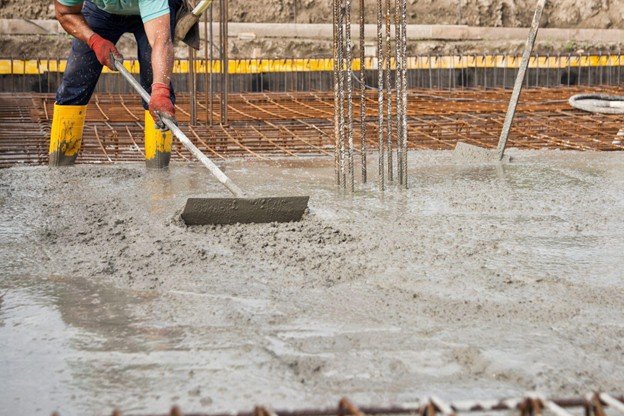
Precision Placement with Rebar Chairs. Steel reinforcement is useless if it is sitting on the dirt. A professional contractor uses plastic or concrete rebar chairs to suspend the steel exactly in the middle of the slab. If you see a crew hooking the rebar and pulling it up during the pour, they are not following commercial best practices.
4. Achieving Certified Floor Flatness (FF) and Levelness (FL)
For modern commercial tenants, especially those using automated robotics or high-reach forklifts, the floor must be perfectly flat. This is measured using FF (Flatness) and FL (Levelness) numbers, which are core Warehouse & Retail Slab Standards in Frisco.
The Difference Between Flat and Level. Floor Flatness (FF) measures the bumpiness of the surface, while Floor Levelness (FL) measures the overall pitch or tilt. A residential crew might hit an FF of 20, but a high-spec warehouse near the PGA District often requires an FF of 50 or higher.
Laser Screed Technology. To hit these high numbers, your contractor must utilize a Laser Screed. These machines use a laser-guided strike-off bar to level the concrete to within a fraction of an inch across thousands of square feet. Manual hand-screeding simply cannot provide the accuracy required for Large-Scale Flatwork Frisco.
Third-Party Profilograph Testing. A reputable contractor will welcome third-party verification. We utilize a Floor Pro profilograph to measure the slab within 24 hours of the pour. This provides a certified report that the floor meets the specific tolerances required by your lease agreement or equipment manufacturers.
5. Moisture Mitigation and Vapor Barriers
A commercial slab is only as functional as the flooring that sits on top of it. In the humid North Texas climate, moisture vapor rising through the slab is the number one cause of commercial flooring failure.
High-Performance 15-Mil Vapor Retarders. We see many contractors try to use thin 6-mil plastic. In our experience, 6-mil plastic is easily punctured by rebar and worker boots. A commercial expert will specify a 15-mil polyolefin vapor barrier. This is a critical requirement for Slab Foundation Requirements in Frisco, TX.
Testing for MVER and Relative Humidity. Before you install flooring, your contractor should perform Calcium Chloride and In-Situ Relative Humidity (RH) testing. Frisco builders typically require a Moisture Vapor Emission Rate (MVER) of less than 3 lbs per 1,000 sq. ft. By planning for this during the initial pour, you avoid the long delays that happen when a wet slab stalls your interior build-out.
6. Navigating Frisco Codes and ADA Compliance
The City of Frisco has some of the strictest building codes in Texas. A contractor who is not local will struggle with the specific Standard Details required by the Frisco Engineering Department. This is why many local developers prefer Concrete Paving Frisco specialists.
Pre-Pour Inspections. In Frisco, you cannot pour until the city inspector has walked the site to verify the vapor barrier and rebar height. A professional contractor handles these scheduling logistics five business days in advance to keep the project on track. This is especially true for Road Construction Standards for Frisco Subdivisions.
The 0.5% ADA Slope Rule. Accessibility is a major liability in commercial construction. Frisco inspectors use digital levels to check every handicap ramp. If a ramp is even 0.5% over the allowed slope, the city will issue a Tear Out order. Your contractor must be an expert in ADA design to ensure your parking lots and sidewalks pass the first time.
7. Commercial vs. Residential Transitions
Oftentimes, a commercial development in Frisco will border residential neighborhoods. Understanding the nuance between Concrete Paving for a business and the standards for subdivision in Frisco is vital.
Subdivision Standards. When building residential access, contractors must adhere to Concrete Timelines for Subdivision Builds in Frisco. The logistics of Planning Concrete Access Roads in Frisco Developments require a contractor who can manage high truck volume without disrupting existing residents.
Driveway and Access Points. Even for commercial entryways, the finish matters. We often integrate Decorative Concrete Frisco to improve curb appeal at office park entrances. However, the structural base remains far superior to a standard Driveway Installation Frisco.
8. Vetting Your Contractor: The Final Checklist
To separate legitimate commercial experts from high-volume residential crews, ask these four questions during the interview process.
Equipment Ownership. Do they own their own Laser Screeds and Power Trowels, or do they rely on rentals? A contractor who owns their heavy equipment has better control over their schedule and quality. This is vital for Large-Scale Flatwork.
Safety Record and EMR Rating. Ask for their Experience Modifier Rate (EMR). A commercial contractor must have a solid safety record to work on high-value sites. If their EMR is over 1.0, it indicates a history of job site accidents.
Insurance Limits. Commercial sites require much higher insurance than residential work. Verify they carry at least $2,000,000 to $5,000,000 in general liability to protect you from project-related litigation.
SWPPP Compliance. Frisco is aggressive about Stormwater Pollution Prevention Plan (SWPPP) enforcement. Your contractor must have a plan for concrete washout to avoid five-figure fines from the city.
Frequently Asked Questions
What is the lead time for a commercial concrete project in Frisco? Typically, you should allow for two to three weeks of lead time for permitting and batch plant scheduling. During the peak construction season in North Texas, this can extend to four weeks.
How does Frisco’s weather impact the pour schedule? Beyond rain, we watch for wind speeds and ambient temperature. High winds can cause the surface to dry too fast. We discuss these mitigation strategies in Avoiding Concrete Delays in Frisco Residential Developments. Is concrete better than asphalt for Frisco developments? Yes. When looking at concrete vs. asphalt for Commercial Developments in Frisco, concrete offers a much higher return on investment due to its ability to withstand the Texas heat without rutting.